Putting Guardrails on my Claude

I run dozens of routines with several AI models every day and I want to enforce constraints on them to (1) prevent hallucinations and (2) reduce token usage. One of the tactics I use involves setting guardrails through Maps of Content. A Map of Content (MOC) is a curated retrieval boundary that I have drawn up for my AI tools to consult before they run off to external sources.
Most of the things I need to examine are directly linked to my laptop through physical file structures or through electronic connectors (e.g., API calls, shared storage locations, webhooks). I think it’s important to create simple outlines of major ideas and inside my Obsidian Personal Knowledge Management system these outlines of hyperlinked ideas are called MOCs.
How a MOC constrains the model
Whenever I start a new project, I chat about its terms of reference. Sometimes this means I make an audio note to self that transcribes into a Markdown file in outline form. That transcript could become the basis of a simple MOC for a project and it would display inside Obsidian as a knowledge graph or as clusters of dots (below).
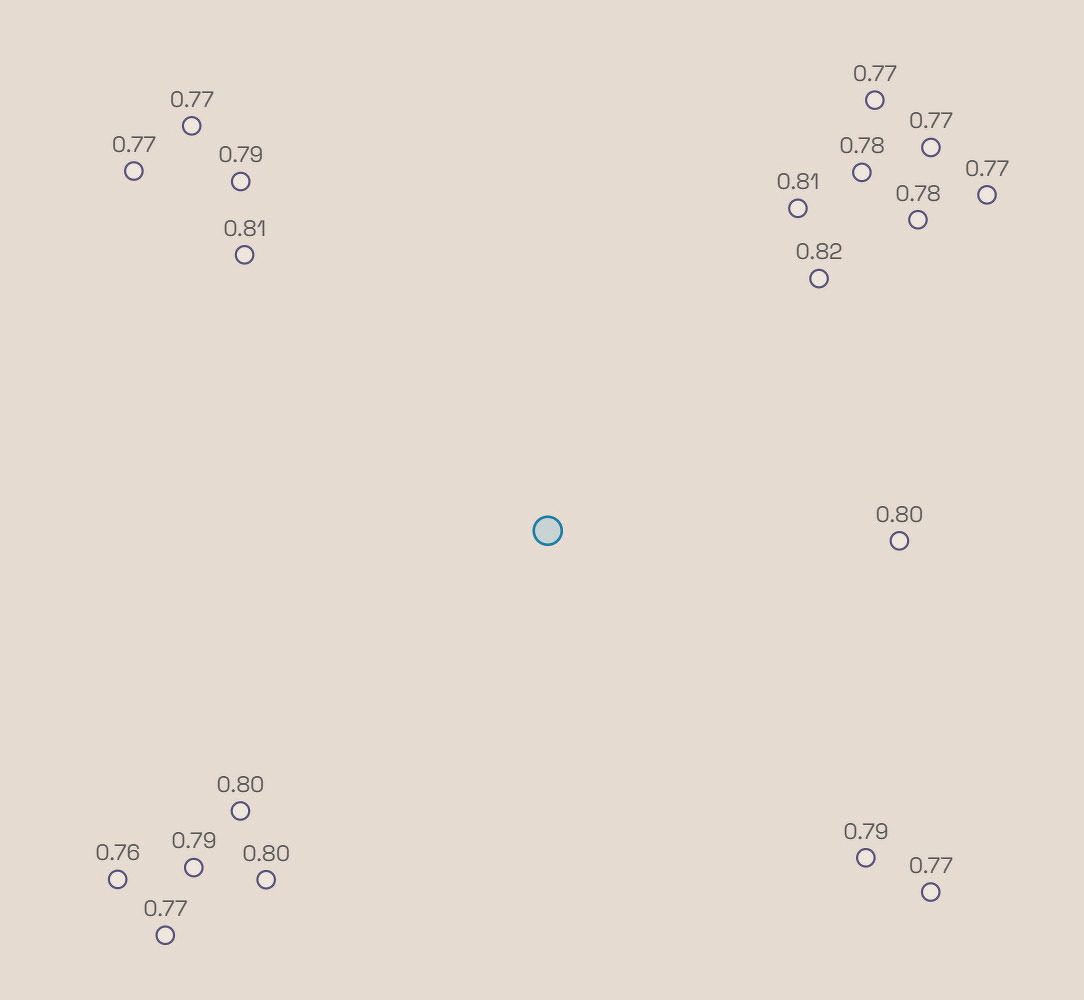
The image above shows a MOC that I made with content related to one of my frequent collaborators. The centre blue dot in the middle is the MOC. The middle dot is just a listing of ideas I’ve discussed with Frances O’Donnell, meetings we’ve held, or workshops we’ve presented. Each of these items is related to other items of interest that show up as dots in different locations on the canvas. The cluster of seven dots at the one o’clock position relate to MOCs as elements of personal development. The single dot at three o’clock is a page of information about traditional map-making. Two dots in the five o’clock position explain systems architecture concerning the mapping of content. In the seven o’clock position sit five dots that cover different perspectives about thinking. And in the 11 o’clock position are four dots that point to nerdy explanations about MOCs.
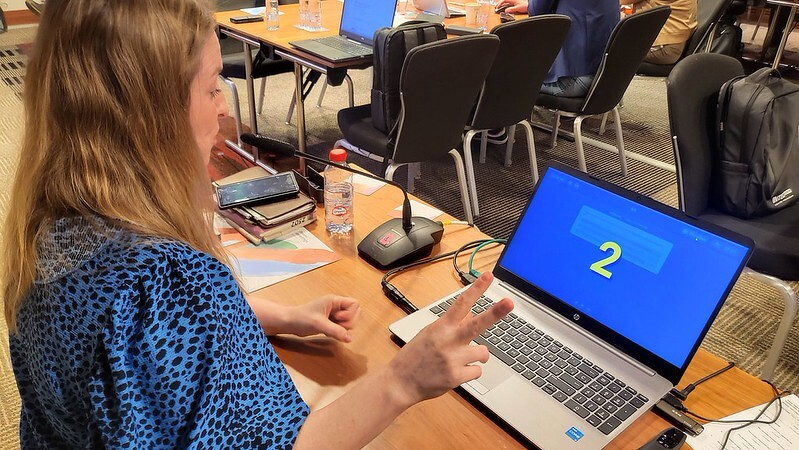
I make MOCs from my research materials when creating conference workshops. This process sets up guardrails because the MOC bounds the retrieval set that I use to develop the training. The workshop idea, specified by my MOC outline, preserves my role as the ultimate author and quality check. Any AI that I might use to produce outputs such as slide decks and gamified content is constrained to personal knowledge sources I have set up. The MOC holds the list of approved sources.
Built-in guardrails
When I iterate or extend workshop content by using an AI as my virtual assistant, the model answers from my MOC’s links rather than parametric memory. In my experience, the AI has fewer gaps to paper over and that means there are no hallucinations, because hallucinations stem mainly from knowledge gaps and the impetus the AI uses to find external knowledge. As I prepare to show this MOC method in an OEB26 workshop, I’ll will package some of these ideas in the form of an Educator’s AI Playbook. The MOCs in this Playbook do more than link notes — every bullet carries an author-date and a section anchor . This means a course developer could use my MOC with its maps to trace back to a named source in seconds.
Much of the 26 years of deep research I have compiled leverages large PDFs that would normally consume the context windows I have on the paid AI plans that I use. However, when I list links in MOCs to these research papers, chapter highlights, and technical documents, the MOCs act like compression layers. A few hundred words that I have used as summaries work as a high-signal index instead of 40 source documents. This means the AI model spends context on reasoning rather than on scanning.
Relational positioning helps me remember
I became a big fan of MOCs after watching Nick Milo demonstrate the process with his Ideaverse. Then during the summer of 2025, I watched Alastair McDermott share a dynamic view of a MOC as he created the working outline of a book he published a few months later. Both Nick and Alastair proved to me the value of “Relational Positioning” by showing how MOCs can help me remember better when ideas are not floating in isolation. Like the dots shown in the screenshot above. good ideas can appear as hyperlinks in a spatial constellation. My MOC to a workshop supplies the real bridge, with the up:/related: frontmatter making the relationship explicit rather than inferred.
MOCs can set up failures too
When I teach people about creating, visualising, and thinking, I explain the danger of letting MOCs get stale. If I use my MOCs merely as a part of a manual index, they could quickly become stale. A stale or purely clerical MOC is worse than none because it grants false confidence to whatever Obsidian or my AI agent returns. For that reason, I have scheduled Claude to suggest updates to all of my important MOCs.
I believe it is important to have helicopter views of important ideas and to develop an information architecture that helps to highlight how those important ideas can be repurposed or resurfacing them for new projects. MOCs have been one of the most helpful tools for me.