Carefully using Fable 5 for the week
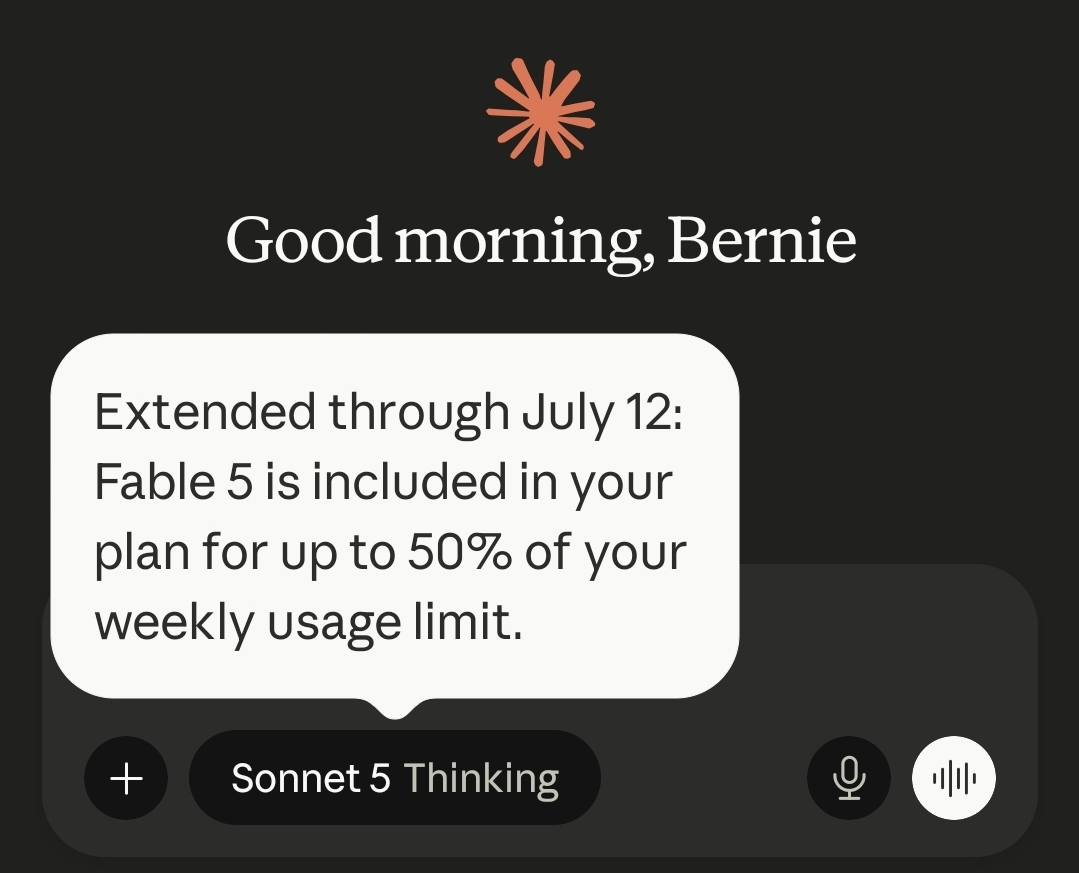
Anthropic is teasing me with Fable 5 but I’m only slow dancing with it. That’s because of its Burn Rate. Fable 5 relies on Adaptive Thinking and that feature is permanently turned on. It maps out multi-step logic behind the scenes, so I don’t give it a massive prompt. I break down logic steps on paper first with boxes and arrows, just like I used to teach students essential elements of process diagrams.
I have consumed massive chunks of tokens and burned through my message limits before. That happens much faster with Fable 5.
What Fable 5 Does Best (And Where to Avoid It)
Fable 5 is a Mythos-class model designed for autonomous, long-horizon projects that typically take hours or days to complete. It is built to navigate ambiguity and manage asynchronous tasks. It can do high-level scoping, build end-to-end multi-file systems, complete complex code debugging, visualise data (love this!), and orchestrating parallel subagents.Fable 5 thrives when given a hard destination rather than explicit step-by-step constraints. But that also burns tokens fast. So I’m cautious.
Where Fable 5 is overkill
If you’re reading this you don’t use Fable 5 to simply generate text, summarise blocks of information, or use it as a chatbot. That’s because you know Fable 5 defaults to its deep reasoning. Running simple queries will needlessly exhaust your 50% weekly allowance.Bonus Tip from Bernie
Start at the very top of your difficulty range. Let Fable 5 act as the “architect” to map out a workflow or project structure, then explicitly instruct it to delegate or hand off the heavy lifting of routine text generation/standard code execution to more lightweight models to preserve your tokens.Back to work.